 Handcrafted in Canada
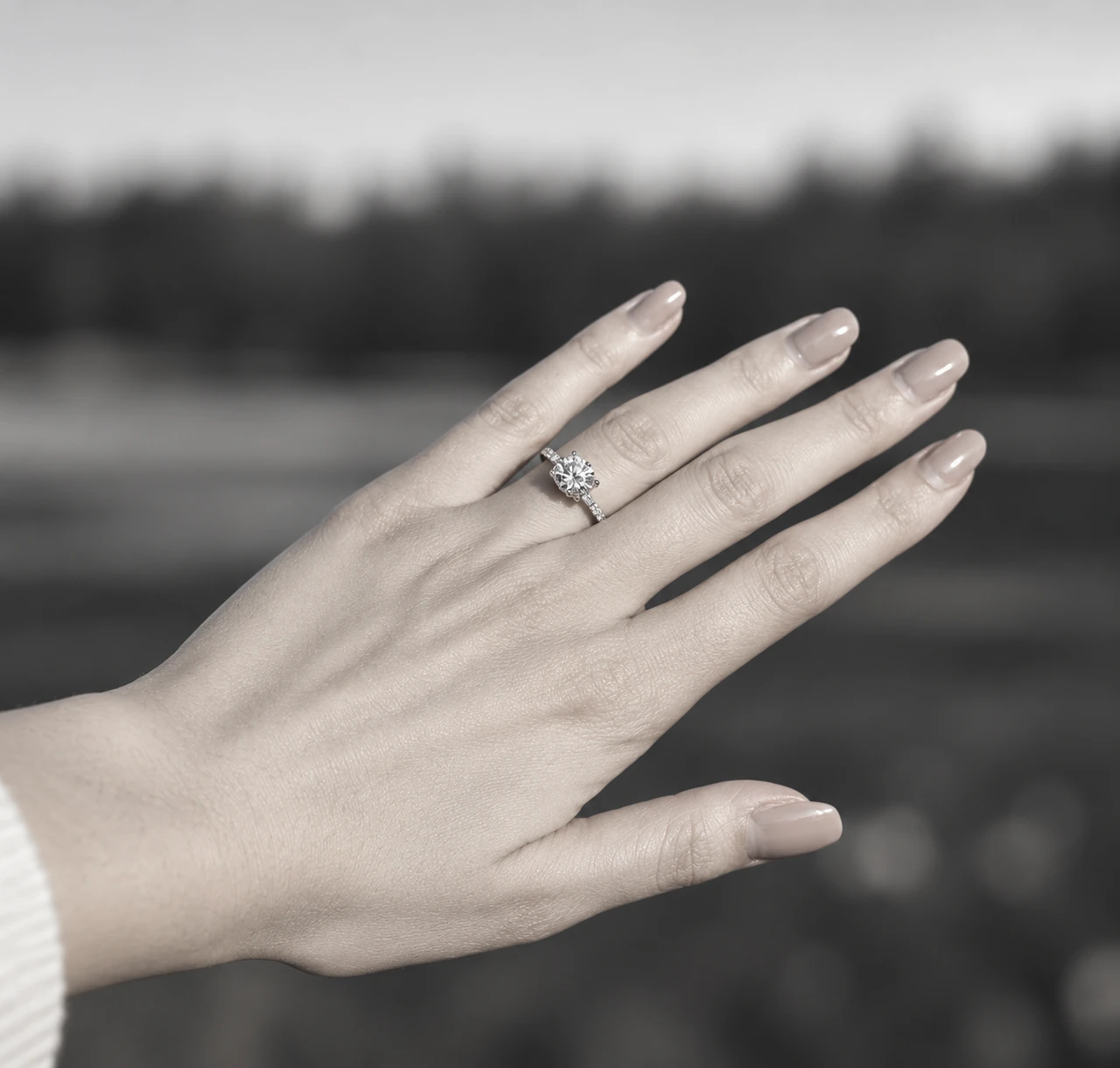
An engagement ring can catch your attention in a photograph and feel quite different on your hand. The centre stone may sit higher than you expected. A slender band might look delicate beside it, while the prongs give the design a more defined outline. Those relationships matter as much as the style name.
In the photograph above, a prominent centre stone, visible prongs and a fine line of accent stones create a clear visual hierarchy. Your eye reaches the centre first, then follows the band. It is a useful starting point for exploring modern engagement ring designs: decide what you want to notice, then consider how the whole ring will feel to wear.
What makes an engagement ring modern yet timeless?
A modern yet timeless engagement ring combines a distinctive detail with proportions you enjoy and a setting suited to your everyday life. That detail might be a sculpted band, a bezel outline or a hidden halo. Lasting appeal is personal; no shape or metal comes with an expiry date, or a guarantee that your taste will never change.
Our advice is to look beyond whether a design is described as classic or contemporary. Consider it from three views: face-up, in profile and beside a wedding band.
The three-view test
Face-up: What holds your attention? Notice the balance between the centre stone, the band and any surrounding diamonds. A simple outline can feel expressive when the proportions are right for you.
In profile: Look beneath the centre stone. Ask to see the basket, prongs and overall setting height. Open and close your hand, and consider how the ring might sit against sleeves or gloves.
Beside a wedding band: Try the two together before finalizing either design. The space underneath the head matters more than the label “solitaire” or “low-set”. Decide whether you prefer a close fit, a shaped band or a deliberate gap. Explore Elysian’s wedding bands with the complete pairing in mind.
Compare five design directions
These are starting points for a conversation, rather than fixed rules about which ring is best.
| Design | Appearance | Comfort to assess | Maintenance consideration | Wedding-band question |
|---|---|---|---|---|
| Solitaire | One clear centre focus | Height and prong finish | Check the stone-holding structure | Does your chosen band clear the head? |
| Pavé band | A fine line of additional sparkle | Band edges against neighbouring fingers | Small stone settings need inspection | Can either ring’s stones touch the other setting? |
| Bezel | A defined metal frame | How the rim and basket feel | Inspect the rim as well as the band | Does the basket leave room underneath? |
| Hidden halo | Detail beneath the centre | Added structure around the gallery | Access for cleaning below the stone | Will the band clear the halo? |
| Three-stone | A broader composition | Outer stones against adjacent fingers | Check all three stone settings | Would a straight or contoured band suit it? |
A useful distinction: “solitaire” describes the overall arrangement, while prongs and bezels describe ways of securing a stone. A solitaire can therefore have a bezel setting. GIA’s setting guide explains these terms and the care considerations behind them.
Solitaire: make the supporting details count
Solitaire engagement rings leave room to notice the band and the prongs. Elysian’s round lab-grown diamond solitaire with a knife-edge band illustrates how a defined band profile can add character without a row of accent stones. Compare that ridge with a softly rounded band on your hand; preference and comfort should guide the choice.
Pavé: consider the whole band
For readers drawn to the fine accent-stone band in the hero photograph, pavé engagement rings offer a related design direction. The emerald-cut lab-grown diamond micro-pavé ring is one collection example to explore. Ask where the small stones finish and what future resizing would involve. A delicate appearance should be discussed alongside the band’s construction.
Bezel: let the outline become the detail
Elysian’s round lab-grown diamond bezel-set solitaire gives the centre stone a continuous metal border. It is worth comparing with a prong-set ring if you enjoy a more graphic outline. A bezel can offer additional edge protection, but it does not make the ring indestructible. Setting height and workmanship still deserve attention.
Hidden halo: judge it from the side
A hidden halo places accent diamonds beneath the centre stone. Elysian’s marquise lab-grown diamond hidden-halo pavé ring combines that detail with sparkle along the band. Ask whether you enjoy both elements together, and request a side view with a wedding band. A hidden detail is worthwhile when you appreciate seeing it, not simply because it adds another feature.
Three-stone: compare the relationship between stones
Three-stone rings invite you to consider the transition across the finger. The radiant-and-princess-cut lab-grown diamond trilogy ring pairs a rectangular centre with square side stones. Notice their relative widths and how the outer settings feel. A broader design can look balanced without the centre being dramatically larger than everything around it.
Proportion before carat weight
Carat measures weight, not a diamond’s visible dimensions. Compare the actual measurements and appearance of individual stones instead of assuming that equal weights will look the same. GIA’s diamond quality guide explains how weight and cut contribute to a diamond’s assessment.
Try several outlines: a round, an elongated oval, an angular emerald cut. Look at them at a normal viewing distance, rather than only through enlarged photographs. There is no single ideal shape for a particular hand.
Then consider band width and thickness. Ask the jeweller to explain the proposed dimensions in relation to your stone and setting. Avoid choosing the thinnest possible band solely to make the centre appear larger. For pointed shapes, discuss how vulnerable tips will be protected; GIA’s care guide explains why even diamonds can chip under impact.
Choose metal with the finished ring in mind
Elysian works with solid 10K, 14K and 18K gold in yellow, white and rose, as well as 950 platinum. Compare the options beside your chosen stone and the jewellery you already wear. A warmer or cooler frame is a style preference, not a measure of whether a ring is timeless.
Ask about the specific alloy, surface finish, skin sensitivities and ongoing care. A metal name alone does not explain every property of a finished ring.
Natural or lab-grown: separate origin from design
Natural and lab-grown diamonds are both diamonds. Their formation differs, while their chemical, physical and optical properties are essentially the same, as GIA explains. Origin cannot be established from a ring photograph.
Either can be considered within the design directions above. Compare individual stones, their documentation and the complete ring quotation. At Elysian, natural diamonds come with GIA grading reports; lab-grown diamonds come with IGI or GIA reports. Our diamond certification guide explains what to review.
Bring specific questions to a custom consultation
When discussing custom engagement rings in Vancouver, bring a few references and explain what you like about each: the prongs, band proportions, side profile or way two rings sit together.
Elysian’s process includes selecting the design and centre stone, reviewing a 3D CAD model and rendered views, and approving the final design before production. Use that review to discuss dimensions and wedding-band clearance. CAD helps communicate the design, while an in-person comparison helps you judge how different proportions feel on your hand.
Frequently asked questions
Which modern engagement ring design is easiest to keep timeless?
There is no universal winner. A solitaire or bezel can provide a straightforward starting point, but pavé, hidden-halo and three-stone designs can also have lasting appeal. Choose proportions and details you enjoy without needing a trend label to justify them.
Are pavé engagement rings suitable for everyday wear?
They can be, with appropriate construction and care. Discuss your activities, how the small stones are secured and the recommended inspection routine. Pavé can complicate resizing, so ask about that before ordering rather than assuming every adjustment will be straightforward.
Will a low-set engagement ring sit flush with a wedding band?
Not necessarily. The basket or another part of the setting may occupy the space a straight band needs. Try the actual pairing, or review both designs together. A contoured band or intentional gap may suit your preferences better.
Does a hidden halo change the centre diamond?
No. It adds separate accent stones below the centre; it does not change that diamond’s cut or grading characteristics. Judge the side-view detail on its own merits and check how it works with your intended wedding band.
Can I customize a design from Elysian’s collection?
Personalization is available where offered, including options such as diamond size, gold colour, karat and ring size. More substantial design changes can be discussed as a custom project. Confirm the available options and specifications for your particular ring.
Can I compare designs before deciding?
Yes. Elysian offers free, 30-minute consultations with pressure-free guidance and no obligation to purchase. Meet by appointment at 777 Hornby St #623, Vancouver, BC V6Z 1S2, or discuss a virtual consultation.
Find the details you want to live with
Begin with the engagement ring collection, then look again from the side and beside a wedding band. If you would like help comparing those details, book a consultation. The aim is a ring that makes sense to you in every view.